
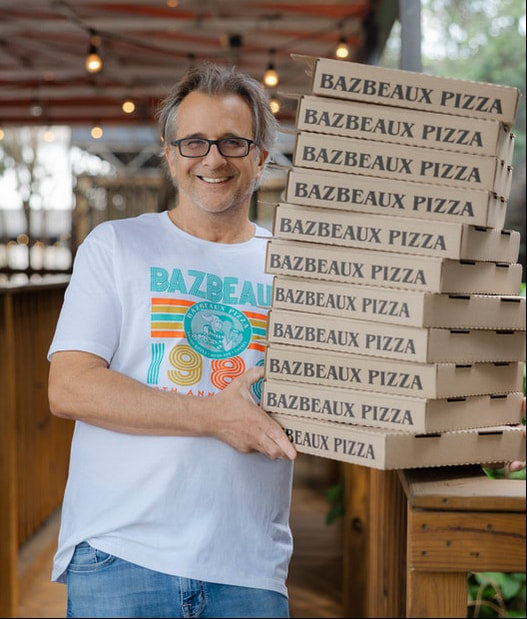
Where the Proof Is in the Pie
From a scrappy Broad Ripple storefront to an institution, Bazbeaux Pizza celebrates its 40th anniversary on May 12th, 2026, marking four decades of dough-making, community-building and staying exactly, stubbornly itself.


|
It wasn't supposed to be pizza. When Indianapolis born-and-raised Jeff Berman opened his first restaurant in Broad Ripple in May 1986, he knew takeout had to be part of the equation. He needed something the tiny space with only a few dozen seats could pull off in the dead of winter when the patio sat empty. Cajun food was the original idea, a nod to his college years in New Orleans. But pizza made sense.
What nobody predicted, though, was what Bazbeaux would become. With 50 toppings, scratch-made dough and combinations nobody in Indianapolis had tried yet, it drew a diverse crew that was fiercely devoted—many the kind of people who made a whole career out of showing up and making something special. Many of them are still there. Three years in, Bazbeaux pushed further into the city. Massachusetts Avenue in 1989 was quiet, with only a handful of restaurants, a couple of bars and some art galleries on a strip that hadn't figured out what it wanted to be. "There was nothing going on," Jeff says. "Now, of course, it's a thriving entertainment district." Over the years, both of those early locations outgrew themselves, and both were able to move across the street into larger spaces—though the spirit of the place hasn't moved an inch. Carmel came in 2005, and in some ways it completed the picture. All three Bazbeaux locations sit on or just steps from the Monon Trail. It wasn't a master plan, but it became a throughline. "They're all in walkable entertainment districts," says Jeff. "They're all on or close to the Monon Trail. We always thought that was kind of cool." Each shop catches the full energy on a spring afternoon in the city, with outdoor tables filling up, foot traffic steady and the neighborhood humming with arrival. Today, each pizza is still made with the same care and attention as it always has been. Every prep crew arrives early to make the day's dough from scratch, season the sausage in-house and build the foundation for the night ahead, including hand-sliced meats, Amish chicken and scratch-made salad dressings (like the locally famous creamy basil). The Quattro Formaggio has been the top-selling specialty pie for all 40 years and has never left the menu. The just-added Full Boar and a house-made hot honey show the kitchen is still curious. |
The most telling thing about Bazbeaux at 40 isn't the pies or the patios, it's the people. Joe Behringer has worked at the Broad Ripple location for 35 years, starting as a dishwasher. “Jeff has always been a good boss and owner. He takes good care of us,” he says, adding that it all starts by taking good care of the customers.
Ben Schimmel, who manages the Carmel restaurant, came to Bazbeaux 25 years ago as a line cook (his third job on top of art school at the time) and never left. The friendships he made in those early years stuck too—many of that original crew are still in his life today. Over the years he has watched the staff in Carmel do the same, a new circle of friends building something together the way he once did. "I didn't anticipate being at the company this long," he says. "It's nice knowing who you work for and being able to talk to them. Jeff allows autonomy. He lets you make mistakes and make decisions on how the restaurant runs," adding that the employee retention here is unlike anything else in the restaurant industry. Matt Spence, general manager at the downtown location, has also been at Bazbeaux for 25 years. Several locations and positions later, Matt likens Bazbeaux team and patrons to chosen family, which makes the job very rewarding. Jeff’s own son Max Berman also works as a manager downtown. “Bazbeaux has always been more than a job to me,” says Max, who grew up rolling silverware with Amber (who is also still at Bazbeaux) after Saturday tennis practice while his dad did paperwork in the back office. “It’s been a huge part of my life. I’m proud to have a role in serving this amazing community. We have the best regulars, and a lot of them have become real friends outside of the restaurant.” The list of people shaped by this place goes beyond the walls of any one location. More than a few who learned the craft here went on to open pizza places of their own across town, something Jeff speaks of not as competition but as legacy. Forty years is a long time to keep a pizza place running. In Bazbeaux's case, it reads less like survival and more like proof. |
Find Bazbeaux Pizza at 811 E. Westfield Boulevard in Broad Ripple, 329 Massachusetts Avenue in downtown Indianapolis and 111 W. Main Street in Carmel. View menus, hours and more at bazbeaux.com. Follow @bazbeaux on Instagram.